
The most reliable shirt size distribution comes from the people who will wear the shirts. If you have a known group, collect sizes against the exact garment you plan to order. If you are buying for unknown attendees or future customers, use relevant past demand and treat the result as an estimate.
There is no universal size ratio that can tell you what your particular school, business, church, or event needs. A useful plan separates confirmed requests from estimated inventory, checks the garment’s available size range, and makes room for uncertainty without filling a closet with expensive guesses.
Here is how to turn a scattered list of sizes into an order you can explain and check, whether you are outfitting a Springfield, MO volunteer team or stocking a community event table.
Start your shirt size distribution with the order type
A fixed roster and an open merchandise table are different planning problems.
For a fixed roster, your goal is to match each person’s request. Employee shirts, volunteer uniforms, and camp shirts usually belong in this category when you know the participants before ordering. Collect responses instead of substituting a generic percentage split.
For an event giveaway or retail table, you may not know who will ask for a shirt. Your goal is to estimate demand using the best information available, then decide how much leftover inventory you are comfortable carrying.
A mixed order needs two separate sections: confirmed shirts for named people and additional stock for everyone else. Keeping those sections separate prevents an estimated size split from accidentally replacing an actual request.
Choose the garment before collecting sizes
A size label is only useful when people know which garment it refers to. Ask for the product style, size chart, available sizes, and fit description before sending out your form.
Do not merge youth medium and adult medium into a single “M” column. Also keep different cuts or styles separate. If your order includes a relaxed tee and a fitted option, record the garment choice as well as the size.
Give participants the manufacturer’s measurement instructions with the chart. If the chart lists finished garment measurements, have people compare those with a shirt they already like using the stated measuring method. Do not compare a flat garment width directly with a body circumference as if they were the same measurement. For example, SanMar distinguishes laid-flat product measurements from body measurements; use the instructions for your chosen style.
If practical, ask whether samples are available for trying on. This can be especially useful when changing garment styles. Confirm the sample arrangement before promising a fitting session to your group.
What information belongs on a size form?
Use one central form or spreadsheet. Include:
- The person’s name and a contact method for corrections
- Exact garment style and color, if there is a choice
- Size category, such as youth or adult
- Size and quantity
- Whether the entry is confirmed or still awaiting a response
For a family order, allow separate entries for each garment rather than asking one household to put several sizes in a notes field. For an employee order, collect fit preferences privately rather than discussing them in a public group message.
Set a response deadline that leaves time to resolve missing or unclear entries before the production order is finalized. Send the selected style and chart with the reminder so people do not have to hunt for the original message.
The broader coach’s guide to custom team uniforms covers names, numbers, and team-order planning. Your size sheet should remain focused enough that you can verify every garment and quantity without searching through unrelated notes.
Build the confirmed count first
Once responses arrive, total them by exact product and size. Keep unanswered requests separate; a blank answer is not a medium.
Check for duplicate submissions, corrections sent by email, and quantities greater than one. Where two responses conflict, ask the person which one is final. Mark that resolution in your order file so a later helper does not reintroduce the old entry.
Before purchasing, the total across all size columns should equal the total number of garments requested. It may be different from the number of people. Forty volunteers receiving two shirts each need eighty garments.
Ask the shop to confirm availability before treating the sheet as final. If a size or color is unavailable, approve a specific substitution with the affected wearer. Avoid quietly moving someone into a different size because that option is easier to source.
An adjustable example for estimated stock
Suppose you need 100 adult shirts for an event table and have no individual preorders. In this hypothetical example, a comparable earlier event sold the following 50 shirts:
| Adult size | Prior event sales | Starting estimate for 100 shirts |
|---|---|---|
| Small | 5 | 10 |
| Medium | 12 | 24 |
| Large | 16 | 32 |
| XL | 11 | 22 |
| 2XL | 4 | 8 |
| 3XL | 2 | 4 |
| Total | 50 | 100 |
Doubling those counts gives a starting estimate that totals 100 shirts. It does not account for a changed audience or unmet requests at the earlier event.
This is an arithmetic example, not a recommended size ratio or a claim about what people generally wear. The pattern belongs only to the fictional prior event. Your own event could have a completely different distribution.
Before using past sales, ask what they left out. Did you run out of a size early? Were some sizes never offered? Did customers accept a second-choice size? Sold quantities show what was available and purchased, which may differ from what people wanted.
If your notes showed repeated requests for 3XL after it sold out, you might move units toward that size. Record why you made the adjustment. If the next audience or garment changes substantially, collect new information instead of assuming the old pattern transfers.
Handle percentages and rounding carefully
To convert your own size history into percentages, divide each size count by the total count. Multiply each percentage by the new order quantity.
When that produces fractions, round down initially and check the remaining units. Assign those units to the largest fractional remainders, then review the result against what you know about demand. This keeps the total correct without independently rounding every size upward.
For small orders, percentages can create false precision. A one-shirt difference matters much more in an order of twenty than in an order of several hundred. Keep the final quantities visible and use judgment about actual participants instead of treating a spreadsheet formula as a substitute for context.
How many extra shirts should you order?
An extra shirt should have a purpose: a late volunteer, an exchange, a replacement, or an additional sale. Write down that purpose and the budget available for it.
Avoid automatically adding the same percentage to every size. For a known group, pending registrations or actual prior requests may give you a better guide. For unknown buyers, review the availability of reorders and the cost of holding unsold stock.
Ask whether a later small order can use the same garment and decoration approach. Our screen printing service can suit coordinated group runs, with minimums confirmed at quote. A small reorder deserves its own quote and availability check. The original unit price and delivery plan should not be assumed to apply again.
If individual ordering fits your situation, DDESIGNS online stores give people a way to select their own merchandise and sizes. Stores are free to set up and free to keep open, with no minimums. That can reduce the need to forecast inventory for optional spirit wear or ongoing apparel purchases.
Keep the results for next time
After distribution, record what people requested, what they received, what remained, and which sizes were unavailable. Separate genuine extra stock from shirts already assigned to someone who has not picked up.
That simple record turns next year’s order into an informed decision. It also shows whether the issue was the quantity, the fit of the chosen garment, or the way sizes were collected.
FAQ: shirt size distribution
Is there a standard T-shirt size ratio for every group? No single ratio reliably describes every audience. Collect actual requests for a known roster, or use comparable demand history when buying inventory for unknown attendees. Keep any estimate separate from confirmed orders.
Should youth and adult sizes go on the same order sheet? They can share a file, but they need separate product and size categories. A youth medium and an adult medium are different garments. Include the exact style so the person placing the order cannot confuse them.
How do I estimate sizes for 100 event shirts? Start with relevant prior demand or preorders rather than a generic percentage chart. Scale the counts to 100, make sure they add up, and review shortages from the earlier event. The example above demonstrates the arithmetic, not a universal recommendation.
Should I order extra shirts in every size? Only when the expected need and budget support it. Decide whether extras are for exchanges, late signups, or sales, then use that purpose to choose quantities. Ask about reorder options before buying a large buffer.
Can an online store remove the need to guess sizes? For optional merchandise, an online store lets each buyer choose their own garment and size. DDESIGNS stores are free to set up and free to keep open, with no minimums. Buyers still need the correct product chart to make an informed selection.
Put your size plan to work
Ready to check your shirt size distribution? Request a quote from DDESIGNS or call 417-839-5222 with your garment idea, confirmed counts, estimated extras, and needed-in-hand date. Our Springfield team can help review the options. Delivery dates are set at the time of purchase, so you’ll always know exactly when your order will arrive.
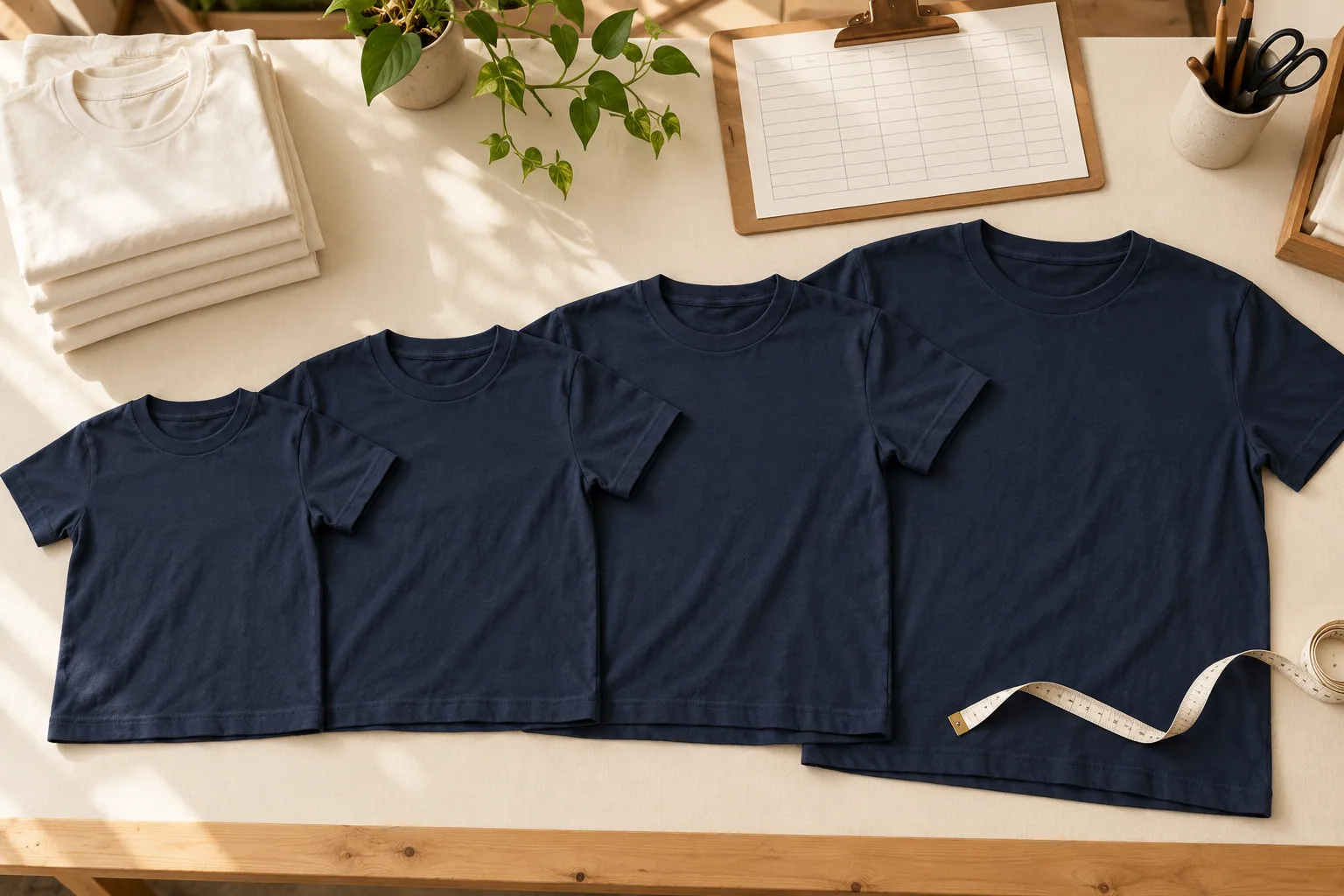
Featured image: AI-generated product illustration.