
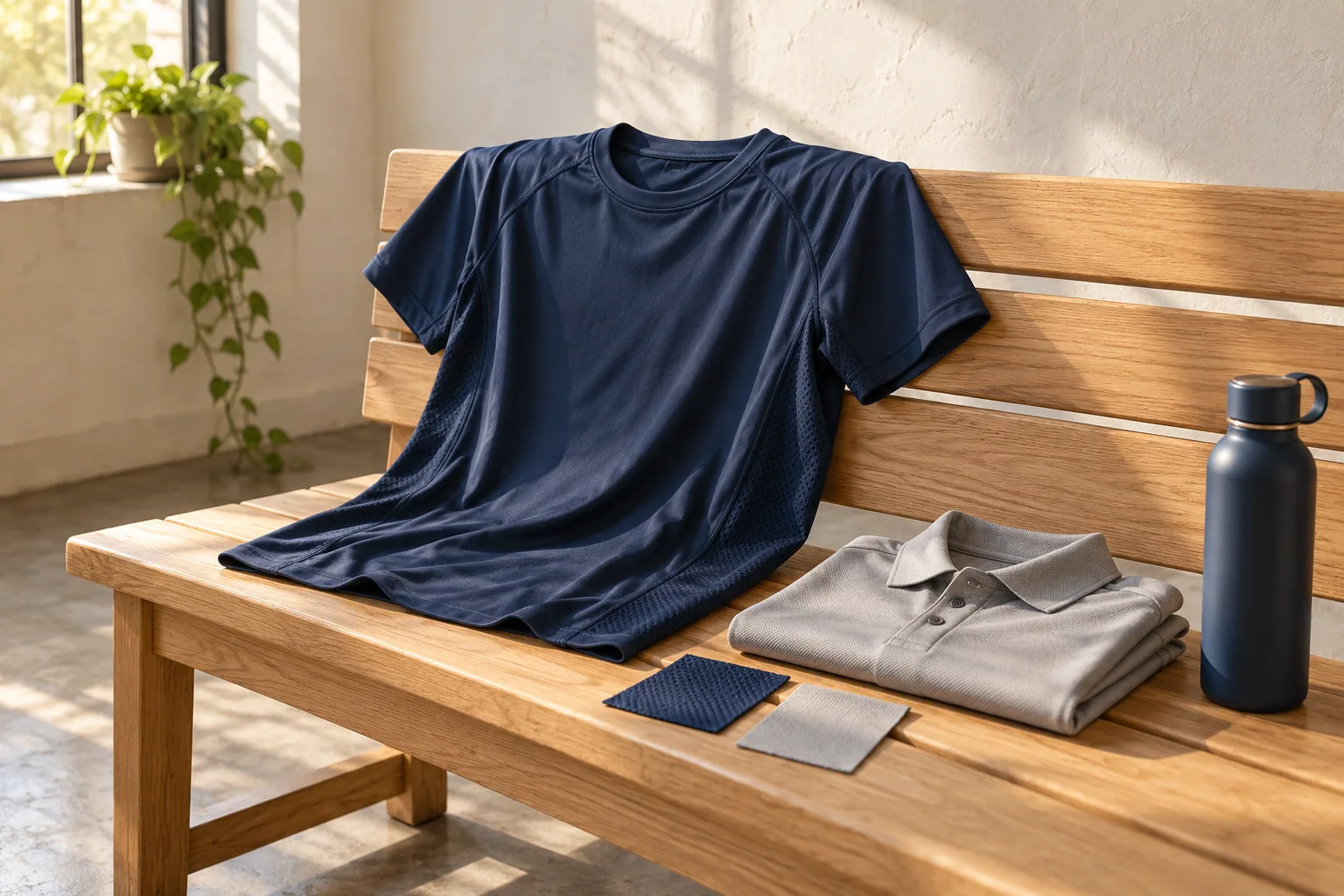
Quick answer: Performance wear is clothing designed with features for activity, such as moisture management, stretch, or lightweight construction. The label covers many products, so choose by the specific garment’s fabric, fit, and documented features. For custom team apparel, evaluate the shirt and its decoration together so both suit how people will move, work, and wear it.
A community race shirt, a coach’s sideline polo, and an outdoor event crew’s tee have different jobs. Start with a typical day in the shirt rather than choosing from a product name alone.
Performance wear features at a glance
| Feature | What it describes | What to check before ordering |
|---|---|---|
| Moisture-wicking | Movement of liquid moisture through the fabric | The manufacturer’s stated moisture-management features |
| Quick-drying | How readily a wet garment dries under given conditions | Product information and the conditions in which it will be worn |
| Breathability | Passage of air or moisture vapor through the material | Fabric construction and comfort during the intended activity |
| Stretch | The fabric’s ability to accommodate movement | Fit through the shoulders and compatibility with the decoration |
| Lightweight | A relatively low fabric weight | Coverage, feel, and whether the group prefers more substance |
| Protective rating | A separately documented product characteristic | The actual required rating; never infer one from “performance” |
Use this as a shortlist of questions. A shirt can have one feature without having all the others.
What features should you look for in performance wear?
Performance apparel often includes features intended to improve comfort during activity. You might see descriptions such as moisture-wicking, quick-drying, breathable, or stretch fabric. Those terms describe different characteristics and should not be treated as interchangeable.
Moisture-wicking fabric is designed to move sweat away from the skin toward the outside of the material, where it can evaporate. Nike’s explanation of moisture-wicking fabric describes the movement of moisture through small channels in the fabric. That is a general explanation of the mechanism, not a claim that every performance shirt works identically.
Stretch describes how the material accommodates movement. Breathability concerns the passage of air or moisture vapor through fabric. Quick-drying describes how readily a wet material dries under given conditions. Look for the features relevant to your group rather than assuming one word covers them all.
A product description that simply says “performance” gives you a starting point for questions, not enough information to make the final choice.
Start with a typical day in the shirt
Tell your apparel shop what people will actually do. “Company shirts” is broad. “Staff will alternate between helping customers indoors and carrying event supplies outside” is useful.
Think through these details:
- How much walking, reaching, lifting, or running is involved?
- Will people wear the shirt alone or beneath another layer?
- Does the group need a casual tee, a polo, or a sport-specific jersey?
- Will the garment be worn for a short event or a full shift?
- Does everyone need the same style, or can coordinated styles work?
For a Springfield, Missouri, volunteer event, a clear organization name and comfortable fit may be the priorities. Coaches may want a collared option that allows easy arm movement. A recreational team may need a jersey designed around its sport and required numbers.
Those are planning examples, not reasons to choose one fabric for every situation. Describe the use first and let it narrow the options.
Read beyond the fiber name
Polyester is common in performance apparel, often in blends, but fiber content alone does not describe the whole garment. Fabric weight, knit structure, stretch, seams, and finishing also influence how it feels and wears.
Two polyester shirts can feel quite different. One may be light and smooth; another may feel more substantial or textured. A blend may offer a feel your group prefers, but the percentages alone cannot tell you whether the sleeve opening or shoulder fit will be comfortable.
Compare the actual garment specifications. If available, ask about seeing or trying a sample before a large order. Evaluate how it feels against the skin, whether it provides the coverage you want, and how it looks when worn rather than laid flat.
If you are replacing a favorite shirt, send its brand and style information when possible. “Something like this” becomes a much more useful description when the existing garment can be identified.
Fit matters as much as fabric
An athletic cut is not automatically the best fit for every active group. People may prefer different amounts of room, and size labels vary between styles.
Use the size chart for the exact garment you are considering. Check whether it lists body measurements or measurements of the garment itself; those are not the same thing. Follow the manufacturer’s measuring instructions instead of treating every medium as interchangeable.
When trying a sample, move in it. Reach overhead, bend, and sit down. Consider sleeve length, shoulder movement, torso length, and whether the shirt rides up. If it will be worn over a base layer, evaluate it that way.
For youth and adult groups, keep the size categories clearly labeled. Our coach’s guide to custom team uniforms covers the broader order organization once you have narrowed down the apparel.
Choose decoration alongside the garment
The logo and fabric need to work together. A small chest mark and a large solid back graphic may feel different on the same lightweight shirt. Consider both appearance and the amount of decorated area when planning activewear.
Synthetic fabrics can also require special production considerations. Heat can cause dyes in some polyester garments to migrate into a decoration and change its appearance. STAHLS’ performance wear handbook explains why decorators need to evaluate fabric and application compatibility.
Share the garment information before assuming a method that worked on a cotton tee will suit your performance top. If you already own the garments, ask the shop to review their suitability before bringing in a full batch.
DDESIGNS offers several decoration methods. Our sublimation service is one option to discuss for appropriate jerseys and apparel. A different method may suit another garment or design. The choice should follow the product and intended result, not simply the word “performance.”
Outdoor apparel needs specific requirements
An outdoor crew may need more than an everyday activity shirt. If your workplace specifies protective clothing or a particular garment standard, provide those requirements before selecting apparel.
Do not infer sun protection, flame resistance, or any other protective rating from “performance wear.” Those are separate product characteristics that need explicit documentation for the garment involved. A bright color alone also should not be treated as proof that a shirt meets workplace visibility requirements.
For ordinary event apparel, explain practical preferences such as sleeve length, layering, and where the logo should be visible. For required workwear, start with the actual requirements so the apparel conversation begins with the right constraints.
Plan for care and repeat orders
Read the garment’s care label and ask for instructions that also account for its decoration. Avoid assuming every athletic shirt can be washed and dried the same way. Share the instructions with the people receiving the apparel instead of leaving them with the order organizer.
Keep a record of the approved garment style, color, artwork, placement, and size information. Those details make future discussions easier, even though availability may change. For a recurring staff order, ask about options for coordinating replacements if the original style becomes unavailable.
FAQ: performance wear
Is performance wear always polyester? No. Polyester is common, but performance apparel can use different fibers and blends. Compare the exact product specifications, construction, and stated features rather than treating one fiber name as a complete description.
Are moisture-wicking and quick-drying the same thing? They describe related but different characteristics. Wicking concerns moving liquid moisture through the fabric; quick-drying concerns how readily the wet material dries under particular conditions. Look for the features your group actually needs.
Can performance shirts have custom logos? Yes, when the garment and decoration are compatible. Share the style, color, fiber content, artwork, and placement before ordering so the shop can consider stretch, heat sensitivity, and possible dye migration.
Should everyone size up in an athletic shirt? There is no reliable rule that applies to every style. Use the size chart for the exact garment, identify whether it shows body or garment measurements, and try a sample when practical.
Does performance wear automatically provide sun protection? Do not assume it carries a particular protective rating. If sun protection or another workplace requirement matters, request the relevant product documentation and have the responsible person confirm that the garment meets the requirement.
Choose performance wear around your team
For performance wear in Springfield, Missouri, start with the activity, approximate quantity, size range, logo, and needed-by date. If you have a favorite shirt, include its style information so we understand the fit and feel you want.
Call 417-839-5222 or request a custom apparel quote. We’ll help you compare the garment and decoration together. Delivery dates are set at the time of purchase, so you’ll always know exactly when your order will arrive.
Featured image: AI-generated product illustration.