
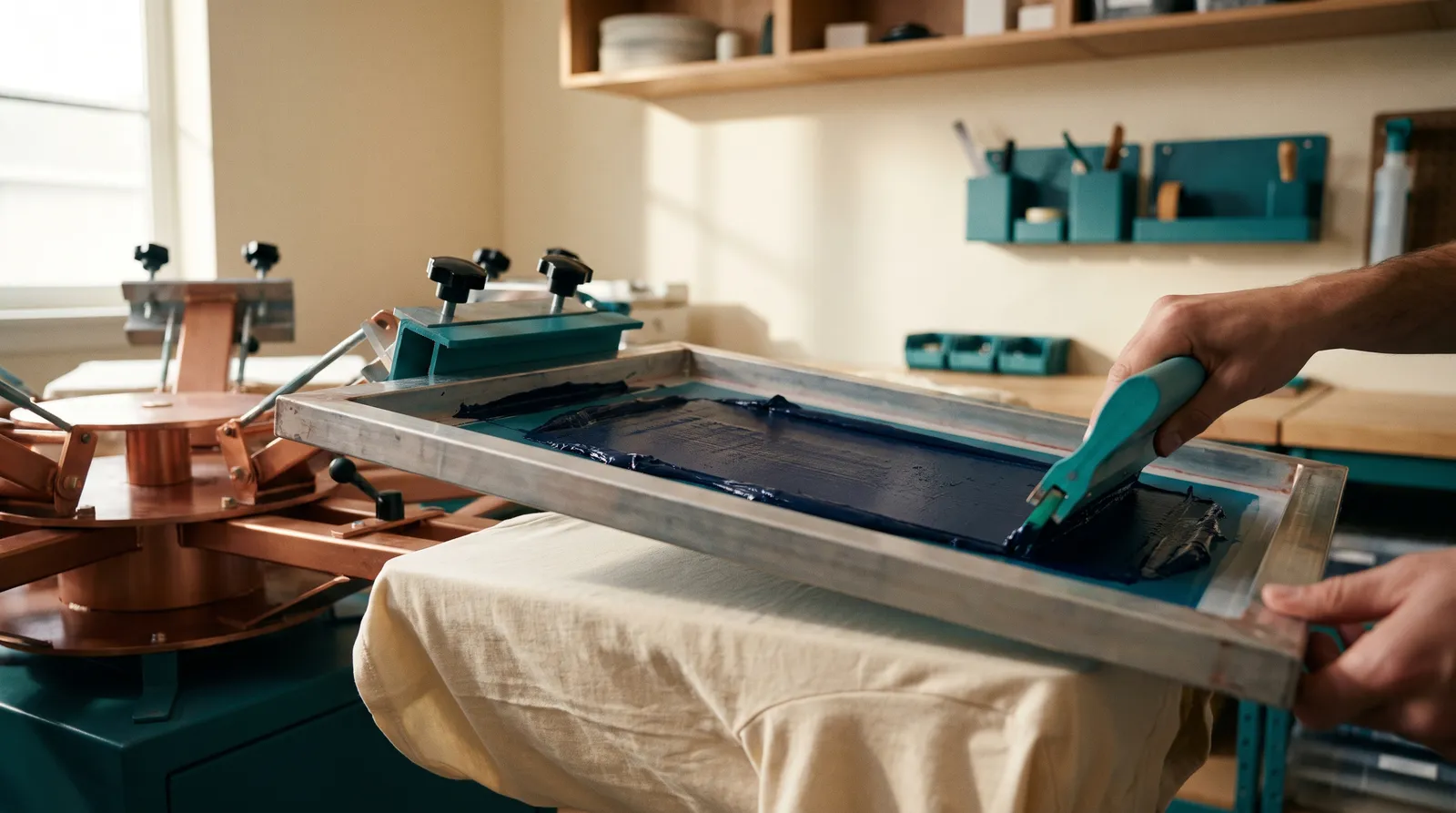
Quick answer: A custom shirt costs whatever the blank garment costs plus the decoration, and the decoration price is driven by four things: how many shirts you order, how many ink colors are in your design, the garment you choose, and how many print locations you need. Larger orders cost less per shirt because setup costs get spread across more units, while small orders often cost more per piece or may not hit a shop’s minimum at all. If you only need a handful of shirts, DTF printing (no minimums) is usually the more affordable route. The only way to get an exact number is a custom quote based on your specific design and quantity.
If you’ve ever gotten two wildly different screen printing quotes for what seems like the same shirt, you’re not imagining things. Screen printing pricing isn’t one flat number — it’s built from a handful of factors that stack together. Understanding those factors won’t just help your budget; it’ll help you design smarter and avoid surprises when you request a quote.
How Much Does a Custom Shirt Cost?
There’s no single number, and any shop that gives you one before seeing your job is guessing. But the question is a fair one, so here’s the honest version of the answer.
The cost of a custom shirt is really two costs stacked together:
- The blank garment — the shirt itself, before anybody prints on it. A basic cotton tee sits at the bottom of the range; a tri-blend, a performance shirt, or a hoodie climbs from there.
- The decoration — the printing or stitching, plus any one-time setup.
That second number is the one that moves the most, and it moves mostly with quantity. Order twelve shirts and the setup cost is split twelve ways. Order two hundred and it nearly disappears into the per-shirt price. This is why two people can ask “how much are custom t shirts?” and get honest answers that are wildly far apart — one of them is ordering for a family reunion and the other is outfitting a school.
Why there’s no “average cost of a t shirt”
You’ll find plenty of pages online publishing an average price per custom shirt. Treat those numbers carefully. An average lumps together a one-color print on a cheap tee at 500 pieces and a six-color print on a premium hoodie at 20 pieces, and the result describes neither job. The average is a real number that answers nobody’s actual question.
What’s more useful is knowing which levers you control:
- Quantity — the single biggest one. If you’re near a price break, adding a few shirts can lower your cost per shirt.
- Ink colors — each color is another screen and another setup. Simplifying a design from four colors to two is often the fastest way to bring a quote down. (Curious what’s actually in the ink? See our guide to plastisol ink.)
- Garment — tell us your budget and we’ll show you blanks that hit it. There’s real range here.
- Print locations — a front print costs less than front, back, and a sleeve.
- Method — for small runs, DTF usually beats screen printing on price because there’s no setup at all.
What it costs to make a t shirt vs. what you’ll pay
If you’re asking how much it costs to make a t-shirt, you’re asking about our side of it: the blank, the ink, the screens, the press time, the labor to set up, print, cure, count, and fold. Setup is the part people underestimate — building screens and registering a press takes about the same amount of work whether the run is 12 shirts or 300.
That’s the whole reason minimums exist, and the whole reason bigger orders get cheaper per piece. It isn’t a markup that scales; it’s a fixed cost getting divided.
What Determines Screen Printing Cost?
1. Number of Ink Colors
Each color in your design requires its own screen, and each screen adds setup time and cost. A one-color design is the most affordable to print; a five-color design costs more because it takes more screens, more setup, and more press time. If budget is tight, simplifying your color palette is one of the easiest ways to bring the price down.
2. Quantity Ordered
This is the single biggest driver of price per shirt. Screen printing has real economies of scale — the setup cost (building screens, prepping the press) gets divided across however many shirts you print. Order 12 shirts and that setup cost is spread thin, so each shirt costs more. Order 200 shirts and that same setup cost barely moves the needle, so the price per shirt drops significantly.
3. Garment Choice
A basic cotton tee costs less than a premium blend, a hoodie, or a performance fabric. Garment cost is a direct line item in your total, so your choice of blank apparel matters as much as the printing itself.
4. Print Locations
Printing on just the front is the most economical option. Adding a back print, a sleeve print, or a second location adds setup and press time, which adds cost. Think through where you actually need the design before assuming every location needs ink.
5. Setup / Screen Fees
Because each screen has to be manually prepped and aligned, most shops charge a setup fee per color, per design. This fee is typically a flat cost regardless of quantity, which is exactly why it matters so much more on small orders than large ones.
What Affects Your Screen Printing Quote
| Factor | Lower Cost | Higher Cost |
|---|---|---|
| Ink colors | 1–2 colors | 4+ colors |
| Quantity | Larger orders (economies of scale) | Small orders |
| Garment | Basic cotton tee | Premium blends, hoodies, performance fabric |
| Print locations | Front only | Front + back + sleeve |
| Design complexity | Simple, bold graphics | Fine detail, gradients, photo-realism |
Why Do Screen Printing Minimums Exist?
Minimums exist because of that setup cost we mentioned above. Building screens and prepping a press takes real time regardless of whether you’re printing 10 shirts or 300. Below a certain quantity, the cost to set up the job outweighs what most customers are willing to pay per shirt — so shops set a minimum order size to keep pricing reasonable for everyone.
That doesn’t mean small orders are out of luck. It just means screen printing isn’t always the right tool for a small job — which is where DTF comes in.
How DTF Helps With Small Orders
DTF (direct-to-film) printing doesn’t use screens at all, so there’s no per-color setup cost and no minimum order quantity. That makes it the better option when you need:
- Just a handful of shirts
- A design with lots of colors, gradients, or fine detail
- A mix of different designs or garment colors in one order
If your project doesn’t hit typical screen printing minimums, ask us about DTF printing instead — it’s often the more cost-effective route for smaller runs, without sacrificing print quality. Read more in our comparison of DTF vs. screen printing.
Typical Cost Patterns (Not a Quote)
Every shop’s numbers differ, and yours will depend on the specifics above, but here’s the general pricing pattern to expect:
- Small quantities tend to have a higher per-shirt cost, largely due to setup fees being spread across fewer units.
- Mid-size orders start to see the per-shirt price drop as setup costs spread out.
- Larger orders (think team sets, school-wide apparel, or company-wide uniforms) typically see the lowest per-shirt cost, since screen printing is built to scale efficiently.
These are general dynamics, not fixed prices — and we deliberately don’t publish specific numbers here, because your actual cost depends on your design, quantity, and garment choice. The fastest way to get a real number is to send us the details for a custom quote.
How to Get an Accurate Screen Printing Quote
To get the most accurate number quickly, have these details ready when you reach out:
- Quantity — how many total pieces you need
- Garment type — t-shirt, hoodie, polo, etc.
- Design — how many colors, and where it goes on the shirt
- Print locations — front only, or multiple spots
- Timeline — when you need the order completed
The more specific you can be, the faster we can get you a real, usable number instead of a wide range.
A Local, Straightforward Approach
We’re DDESIGNS, a family-run screen printing and custom apparel shop in Springfield, Missouri, and we’ve been quoting jobs like yours since 2008. We won’t quote you a number that doesn’t hold up once we see your actual design — we’d rather ask a couple of quick questions upfront and give you pricing you can trust. And if your order doesn’t make sense for screen printing, we’ll tell you that too, and point you toward DTF printing or another option that fits better. Quality you can trust, without the runaround.
FAQ: Custom Shirt & Screen Printing Cost
How much does screen printing cost per shirt? It depends on your quantity, number of ink colors, garment choice, and print locations. Larger orders and simpler designs cost less per shirt; small orders and multi-color designs cost more. The most accurate number comes from a custom quote.
Why does screen printing have a minimum order? Screen printing requires building a separate screen for each ink color, which takes setup time regardless of order size. Minimums exist so that setup cost doesn’t make small orders disproportionately expensive.
Is screen printing cheaper than DTF printing? For larger quantities of the same design, screen printing is usually more cost-effective. For small orders or highly detailed designs, DTF printing is often cheaper since it has no setup fees or minimums.
What’s the cheapest way to print custom t-shirts? For bulk orders of one simple design, screen printing with fewer ink colors is typically the most economical option. For small orders, DTF printing tends to be more affordable since there’s no setup cost.
Does the number of colors in my design affect the price? Yes, significantly. Each color requires its own screen and setup step, so designs with more colors cost more than simple one- or two-color designs.
Can I get screen printing without a minimum order? Most screen printing minimums exist for cost-efficiency reasons rather than strict shop policy. If your quantity is below a typical minimum, we’ll usually recommend DTF printing instead, since it has no minimums at all.
How much does a custom shirt cost? It depends on the blank garment you pick, how many you order, how many ink colors are in the design, and how many places it prints. A basic cotton tee with a one-color front print at a healthy quantity is the least expensive combination; a premium garment with a multi-color design at a small quantity is the most. Send us the details and we’ll give you a real number instead of a range.
How much are custom t shirts for a small group? Small orders carry a higher cost per shirt with screen printing, because the setup gets divided across fewer pieces. For a small group, DTF printing is usually the better answer — no screens, no setup fee, and no minimum — so you’re not paying bulk-order setup on a dozen shirts.
What’s the average cost of a t shirt? We’d steer you away from averages. A published average blends a 500-piece one-color run with a 20-piece six-color run, so it doesn’t describe either job. Your quantity, garment, and color count will tell you far more than any average will.
How much does it cost to make a t shirt? On the production side it’s the blank garment, the ink, the screens, the press time, and the labor to set up, print, cure, and pack. Setup is close to fixed regardless of run size, which is why the per-shirt cost drops so sharply as quantity goes up.
Do you publish custom t-shirt pricing on your site? We don’t, and it’s deliberate. Any number we posted would be wrong for most of the jobs that come through the door, and we’d rather not quote you something that doesn’t hold up once we see your artwork. Tell us your quantity, garment, and design and you’ll have an accurate number quickly.
Get Your Real Number
Skip the guesswork — tell us your quantity, design, and timeline, and we’ll get you an honest, accurate quote fast. Custom merch made easy, right here in Springfield.
Call us at 417-839-5222 or request your free quote today.