
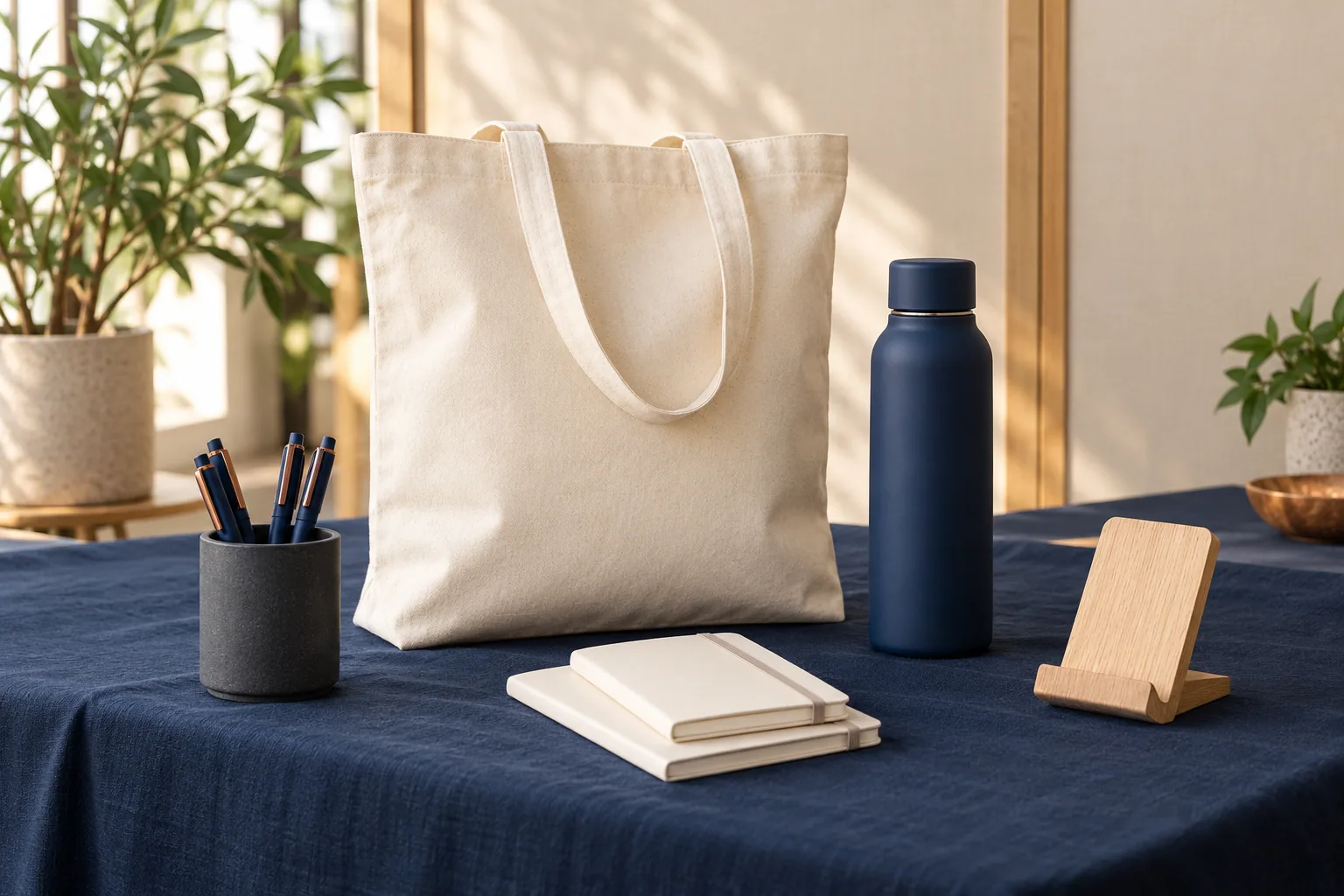
Useful trade show giveaway ideas include pens, notebooks, totes, drinkware, and simple accessories that fit your attendees’ routines. Choose by audience, portability, product quality, and the complete decorated-order cost. Estimate quantities from realistic booth conversations and scheduled meetings, then make the handoff part of a helpful conversation with a clear next step.
Here are practical trade show giveaway ideas, plus a simple way to decide which ones belong at your next booth.
Start with the person walking past your booth
Before comparing colors or adding your logo, describe the person you hope to meet. An office manager attending a business expo has different needs from a homeowner visiting a remodeling show or a parent at a community event.
Ask three questions:
-
What would help this person during the event?
-
Where could this item fit into their life afterward?
-
Does it connect naturally to what our business does?
For example, a notebook makes sense for someone attending educational sessions. A tote can help a visitor carry brochures and samples. A water bottle may suit an audience that spends time outdoors.
Those are starting points, not automatic winners. Consider whether attendees will already receive something similar from the event organizer. One useful item that fills a gap is a better plan than several extras people already have.
Six trade show giveaway ideas worth considering
1. A pen that feels good to use
Pens are easy to carry, easy to share, and useful across plenty of audiences. The difference is in the details: a comfortable grip, reliable ink flow, and a clip that works.
If a sample is available, write with it before placing the order. Check your business name at the actual imprint size, too. A crowded logo or tiny website address won’t become easier to read once it’s printed on a pen barrel.
Keep the message simple enough to recognize at a glance.
2. A notebook with a clear purpose
A compact notebook fits conferences, training events, and business expos where people want to capture ideas. Look at the binding, paper, and size rather than judging only the cover.
Think about how someone will use it: can it sit comfortably on a small conference table? Will it fit in their bag? Is there enough writing space?
You can also hand it out with a useful prompt: “Use the first page for the three ideas you want to bring back to your team.” That gives the item a purpose beyond displaying your logo.
3. A tote that can carry more than brochures
A tote is especially relevant when attendees will spend the day collecting materials. Check handle comfort, construction, and dimensions against what visitors might carry.
Picture the next use as well: library books, a few groceries, or supplies for a meeting. That gives you a practical way to compare options.
Leave breathing room around your artwork. A clear, attractive design is easier to enjoy carrying than a bag covered with every service your business offers.
4. Drinkware that suits the routine
Bottles, tumblers, and mugs can make sense when you can connect the format to your audience. Think desk coffee, a gym bag, or a commute, then compare the relevant product details.
Ask about care instructions, lid design, capacity, and the manufacturer’s stated features. Don’t assume that every lid seals for travel or every decorated product is dishwasher safe.
Drinkware also takes up booth and transport space. Before committing, work out how many boxes your team can bring, store, and move. The same items can work as corporate holiday gifts for clients at year end.
5. A practical tech accessory
A phone stand or cable organizer could fit an audience that works at a desk or travels with devices. Ask which specific products are available rather than assuming every accessory can be sourced for your event.
For anything with connectors or charging functions, verify compatibility and product specifications. An accessory that doesn’t work with someone’s device has little reason to stay in their bag.
Simple can be useful here. Compare how easily the item works, packs away, and fits into an ordinary workday.
6. A small item tied to your audience
A keychain or koozie may fit a community event, outdoor gathering, or audience that values something compact. The question is whether the connection makes sense for your visitors.
A smaller item can also give you room to choose a better version within the same budget. Compare the material, feel, and decoration rather than assuming the lowest unit price is the best value.
Build the budget around the whole order
The catalog price is only one piece of the budget. Ask for a quote that identifies product quantities, decoration, setup charges, shipping, and applicable taxes. Confirm any minimum quantities and price differences between options.
Build a worksheet that separates the main giveaway, any meeting gifts, and the costs needed to get everything to the booth:
| Budget component | What to confirm |
|---|---|
| Everyday giveaway | Item, quantity, decoration, and total line cost |
| Gifts for scheduled meetings | Intended recipients and separate quantity |
| Setup and artwork | Which charges apply to the chosen product |
| Freight and event transport | Delivery destination and booth logistics |
| Taxes and packaging | Applicable charges and any packing materials |
| Total order | Complete approved spend, with any allowance clearly labeled |
If the complete quote exceeds your budget, adjust quantity, product, or decoration before approving it. Compare alternative quotes on the same basis: a lower product price does not settle the decision if other costs differ.
Estimate quantities from realistic booth conversations, scheduled meetings, staffing, and event hours. The event’s total attendance is useful context, but every attendee won’t necessarily visit your table.
Make the handoff part of a useful conversation
Decide how your team will offer the items before the doors open. You might keep the everyday giveaway available to booth visitors and reserve a separate gift for scheduled demos or customer meetings, where appropriate.
Give staff a natural sentence to use: “Would a notebook be useful for today’s sessions?” Then focus on the visitor’s questions.
If you include a QR code or short web address, send people somewhere relevant: an event offer, a service page, or a helpful resource. Test the destination and the printed code at its intended size. Make any signup request clear so visitors understand what they’re agreeing to receive.
Your booth staff should also be easy to identify. Our custom embroidery guide covers a coordinated option for staff polos, while the giveaway stays focused on the visitor.
A giveaway can support a conversation, but it does not replace one. Your team should still be able to explain what you do and help the visitor decide whether it is relevant.
Check the details before you order
At DDESIGNS, our promotional products service starts with your occasion, audience, and budget. We help narrow the choices and prepare artwork for your approval.
Bring your event date and the earlier date you need products in hand for packing or travel. Confirm availability for the selected product and order details before purchasing. Delivery dates are set at the time of purchase, so you’ll always know exactly when your order will arrive.
Review the proof for spelling, logo placement, colors, and readable contact information. After the event, note what people chose, what remained, and which conversations led to useful follow-up. Those observations can guide your next order.
FAQ: trade show giveaway ideas
What makes a useful trade show giveaway? It fits the attendee’s routine, is convenient to carry, and gives your brand a clear place on the item. Pens, notebooks, totes, and drinkware are possibilities rather than universal winners. Compare them against your audience and event format.
How many giveaways should we order? Estimate the conversations your team can realistically handle across the event, then consider scheduled meetings and any separately planned gifts. Total event attendance is not the same as expected booth traffic. Use prior event results when they are relevant.
Are inexpensive promotional products always the best value? No. Compare the complete decorated order, usefulness, product specifications, and transport needs. An item that costs less per unit may still be a poor fit if it is difficult to use or your audience has little reason to keep it.
Should we put a QR code on the giveaway? Use one when the destination is genuinely helpful and the imprint area can support a readable code. Test a printed version at the intended size with ordinary phones. Keep a simple way to identify your business even if someone never scans it.
Can we order a small quantity for a local event? Ask about the exact product and decoration method at your required quantity. Promotional-product minimums vary, so do not apply apparel or online-store policies to every giveaway. Confirm availability, the complete quote, and the needed-in-hand date before purchasing.
Choose a giveaway that fits your event
Comparing trade show giveaway ideas for Springfield, MO or an event farther afield? Request a quote from DDESIGNS or call 417-839-5222 with your audience, quantity, budget, and needed-in-hand date. We’ll help you narrow the options around the people you want to meet.
Featured image: AI-generated product illustration.