
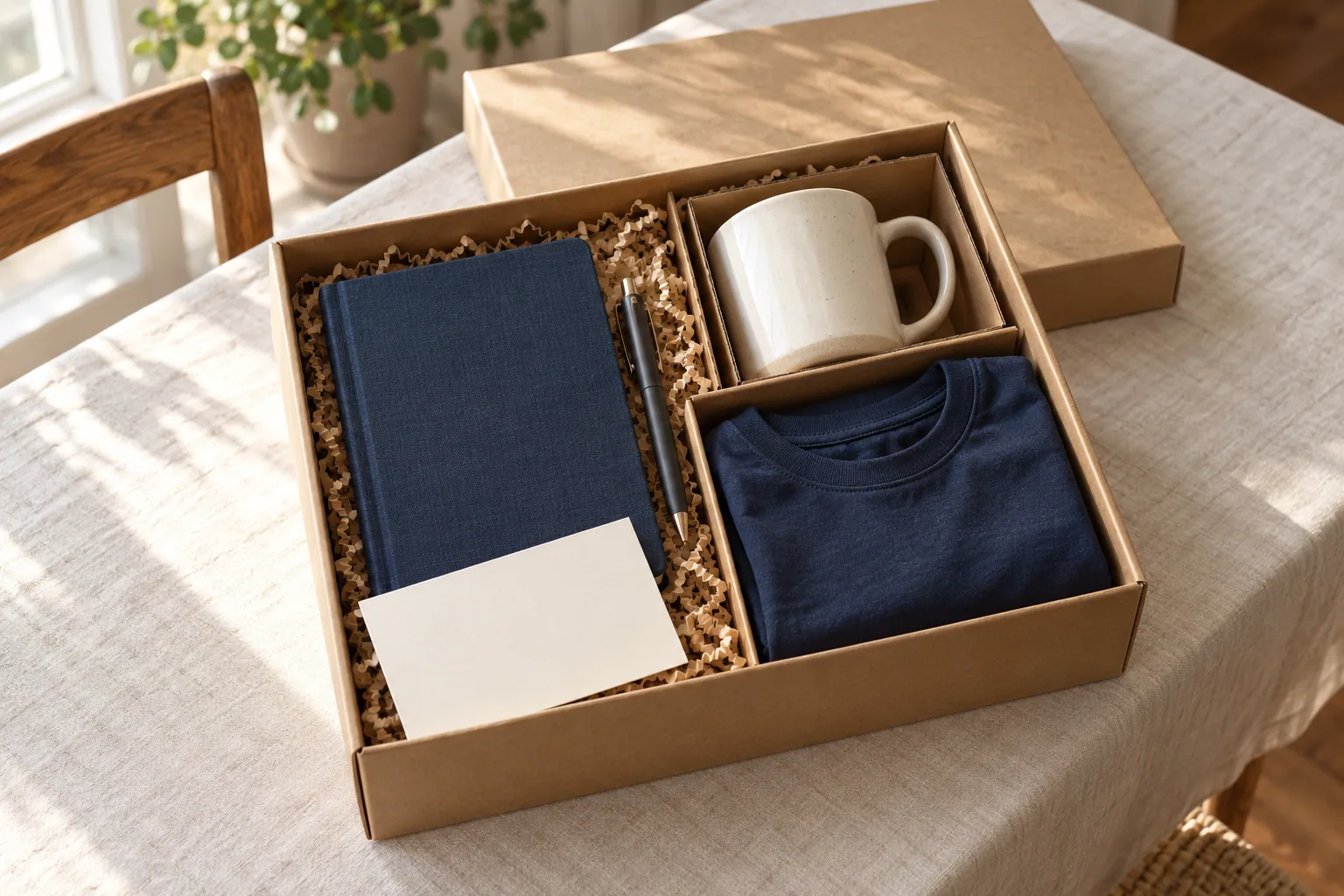
Useful employee welcome kits pair a few workday essentials with a personal note: a notebook and pen for a desk role, a bottle and tote for a mobile team, or compact items for a remote employee. Customer gifts should reflect the relationship and occasion. Choose the recipient, purpose, delivery method, and complete budget before selecting products.
Whether you are welcoming a new employee in Springfield or thanking customers across several locations, begin with the occasion, the recipient, and a complete budget. Those details help you choose products that belong together and avoid surprises when the order reaches the packing stage.
Give each gift a clear purpose
Employee welcome kits and customer gifts serve different jobs. A new employee needs to feel expected and equipped. A customer thank-you should recognize a relationship without feeling like another sales presentation.
Write a short brief before looking at products. For a welcome kit, it might be: “Useful items for a new office employee’s first week, with one piece of apparel they choose themselves.” For customer gifts: “A practical thank-you for customers who completed a project with us this year.”
Include the recipient count, handoff date, delivery method, and maximum total spend. Also identify whether everyone gets the same kit or whether you need a few role-specific versions. Keep the number of versions manageable so assembling the gifts does not become its own project.
| Recipient or occasion | Useful starting point | Check before ordering |
|---|---|---|
| Desk-based new employee | Notebook, pen, welcome note | Writing needs and desk space |
| Mobile team member | Bottle, tote, optional apparel | Carrying needs and confirmed size |
| Remote employee | Compact stationery or accessory pouch | Packaging and delivery arrangements |
| Customer project thank-you | One relevant item and specific note | Named recipient and intended use |
| Customer team milestone | Coordinated gifts for the intended group | Quantity and previous gifts |
Employee welcome kits for different workdays
A desk-based welcome kit
Start with a notebook and a pen that feels comfortable to use. Add a mug if employees have a practical place to wash and store it. Include a welcome note naming the person they can ask for help during the first week.
Before selecting the notebook, consider whether the job involves meeting notes, sketching, or mostly digital work. Page format and size matter more than adding another decoration location. A useful kit should fit the workday, not a generic idea of what an office looks like.
A mobile or field-team kit
A water bottle, a sturdy tote, and an appropriate branded cap can make sense for employees who move between locations. Ask recipients or team leads about carrying space, cleaning needs, and how the items will be used.
Keep promotional gifts separate from required work equipment. An everyday branded bottle or hat should be chosen for convenience and appearance; any job-specific protective equipment belongs in the company’s separate equipment process.
For apparel, collect the employee’s preferred size privately and provide the exact garment chart. Our embroidery and screen-printing comparison can help you discuss the finish for a shirt or jacket, and our custom embroidery page covers stitched logos on polos, jackets and caps. Do not guess a size or present a limited selection as though everyone should fit it.
A remote-employee kit
Think about shipping before you choose fragile or bulky products. A notebook, pen, compact accessory pouch, and personal welcome note can be straightforward to package. If you want to include a mug, account for protective packaging and the overall package size.
Coordinate delivery with the employee’s availability. A box arriving after the first week misses part of the welcome, while a box arriving unexpectedly may be difficult to receive. Collect only the shipping information you need through your company’s normal process.
Customer thank-you ideas that feel personal
After a completed project
Choose one useful item connected to the customer’s setting, such as a desk notebook, drinkware, or tote. Include a specific note thanking them for the project or their trust in your team. The note does the personal work; the product gives the gesture a physical form. Planning gifts for the holidays? See our guide to corporate holiday gifts people actually keep.
Avoid putting a large sales offer in the center of the thank-you. If follow-up service information belongs in the package, keep it clear and helpful.
For ongoing customers
A consistent annual or milestone gift can be easier to manage than a different last-minute idea for every recipient. Pick a product with broad everyday use and consider whether customers have already received something similar from you.
If several people at one company support the relationship, decide whether you are thanking an individual or the whole team. One item addressed vaguely to an office can create an awkward handoff. Match the quantity and note to the intended recipients.
At an event or pickup
A tote, notebook, or pen can be easy to hand over without complicated packing. Consider what the recipient is already carrying and whether the item fits comfortably in a bag.
If the thank-you accompanies a reunion, graduation, or group celebration, our guide to custom shirts for group events can help coordinate apparel with the occasion. Keep the gift selection focused on what attendees will use after the event, too.
Choose one main item, then add with restraint
Build around a main product, such as a bottle, a tote, or an apparel piece. Add a smaller item only when it improves the kit. A notebook and pen are a natural pairing. Three different writing tools may simply repeat the same job.
DDESIGNS offers promotional products including drinkware, notebooks, pens, totes, and other branded goods. Share the purpose and budget first so the shortlist can focus on suitable options.
You can also create a simpler version for routine welcomes and a more substantial version for a specific milestone. Decide the criteria upfront and document what belongs in each kit. That keeps future orders consistent and helps whoever handles assembly avoid improvising.
How do you budget for the whole gift?
The product price is only part of a kit budget. Ask your quote to identify decoration, any applicable setup charges, packaging, inserts, shipping, and other relevant costs. For individual deliveries, distinguish freight to your office from shipping each finished gift to its recipient.
Use this planning formula: total project cost divided by the number of complete, usable kits equals the cost per kit. Spare components may be helpful, but they still belong in the project total.
If the budget is tight, simplify the kit before compromising the main item’s usefulness. One good item and a thoughtful note can be a complete gift. Request options at your actual quantity because minimums and available decoration methods can vary by product.
Review the logo at the product’s actual size
A logo that looks clear on a laptop screen may lose detail on a pen barrel. Ask to review the imprint dimensions and consider whether a simpler logo version is needed. Small text, narrow spaces, and long taglines deserve particular attention.
For coordinated kits, choose colors that work together without assuming different materials will look identical. A fabric tote and a ceramic mug can interpret a color differently. Review the specific products and proofs together.
Ask about a sample when feel, lid operation, writing comfort, or material quality is central to your decision. A digital proof helps approve the artwork; it does not let you test how a product feels in your hand. Confirm sample availability, cost, and timing before building it into your schedule.
Make assembly and reordering manageable
Decide who will receive the products, check quantities, insert notes, and prepare the gifts. Write one packing checklist and assemble a complete example before the full run. Confirm that everything fits the chosen packaging without being forced.
For ongoing employee onboarding, keep a simple stock record by component. Ten notebooks and two bottles do not equal ten complete kits. Record product identifiers, approved artwork, and decoration details so a reorder starts with the right reference.
FAQ: employee welcome kits and customer gifts
What should an employee welcome kit include? Start with one or two products suited to the person’s actual workday and a personal welcome note. A notebook and pen may suit an office role; a bottle and tote may suit a mobile team. Required work equipment needs its own planning process.
How is a customer gift different from an employee kit? A customer gift recognizes the relationship; an employee kit helps someone feel expected and prepared. Match the note, quantity, and product to that purpose. Decide whether a customer gift is for one person or a whole team before ordering.
Should we include a shirt in every kit? Apparel can be useful when the recipient wants it and can choose the appropriate size. Provide the exact garment chart and collect the choice privately. If a reliable size cannot be confirmed, consider a product that does not require one.
Can DDESIGNS make just one welcome kit? Availability and minimums depend on the individual products and decoration methods. DTF printing and online stores have no minimums; that does not make every promotional product or embroidery order a single-item option. Share the proposed components and quantity for a specific quote.
How should we plan kits for remote employees? Choose products with packaging and shipping in mind, confirm recipient details through your normal company process, and assign responsibility for assembly and dispatch. Ask what delivery arrangements are included in the quote. Do not assume an individual mailing service is included.
Build a kit with a clear purpose
For employee welcome kits or customer gifts, request a quote from DDESIGNS or call 417-839-5222 with your recipient count, occasion, budget, and needed-in-hand date. Our Springfield, MO team can help you choose a coordinated set of products. Delivery dates are set at the time of purchase, so you’ll always know exactly when your order will arrive.
Featured image: AI-generated product illustration.